

Most guests know me as Martin Terstall, co-owner of Hibiscus Beach House in Jan Thiel. Together with Diana I spend my days making sure the people staying with us have a relaxed and personal holiday.
But alongside the B&B, football has been part of my life for as long as I can remember. For several years now I have worked as a youth scout for Ajax on Curaçao.
My job is to find and assess young players, roughly between six and fourteen years old, and to build an honest picture of the talent on this island. I record what I see in a scouting and data system. It is a privilege to follow children who dream of playing professionally — and to know that one of them might one day make the step from Curaçao to the Ajax academy in Amsterdam.
What a scouting day looks like
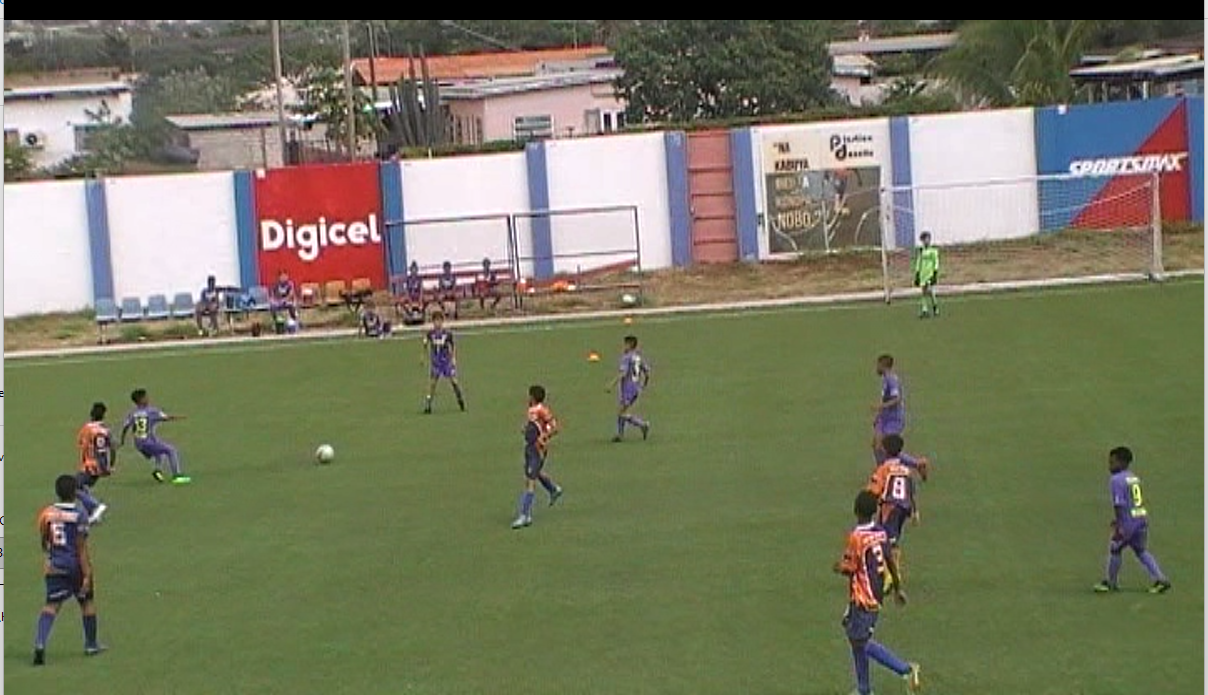
My day starts well before kick-off. I make a point of being early, because the warm-up already tells you a great deal: how a player moves, how he handles the ball, how much concentration and confidence he carries. How he talks to his team-mates and how he behaves towards his coach are part of the picture too.
Once the match starts I am not watching for goals or highlights. I am trying to read the whole of a player’s game. Where does he position himself? Does he see the spaces? How quickly does he decide? What does he do the moment he loses the ball? Does he keep playing when his team is behind? Does he dare to take the initiative?
After one match I can usually tell whether a player is worth following. But a real judgement is never made on one match. A player has to show his qualities over a longer stretch of time.
What Ajax looks for
Ajax is known around the world for its playing philosophy and its academy, and that means scouting there is about much more than pace, strength or how many goals someone scores.
- Technique. A player has to be comfortable on the ball, with a first touch that leaves the ball where he can play it.
- Ball handling, passing and finishing. An Ajax player should be able to pass cleanly and shoot with precision.
- A weapon of his own. A move that beats a defender, an unusual change of pace, creativity, vision, or the nerve to try something unexpected at the decisive moment.
- Both feet. A player comfortable on either foot can turn both ways and is far harder to defend against.
- The Ajax swagger. Not arrogance — confidence. The belief that nobody is going to get the better of you.
A talented player has to dare to play, to take the initiative, and to show what he can do under pressure.
How I find talent
A lot of it comes through tips from coaches, clubs and other people in football here. The rest comes from turning up at youth matches more or less at random — and every now and then a player I had never heard of walks onto the pitch and makes himself impossible to miss.
When someone catches my eye, I try to follow him over a longer period. That matters, because any young player can have an exceptional day or a poor one. Watching him repeatedly gives a far more reliable picture of his technique, his development, his behaviour and his mental resilience.
How many players I follow in a month varies a lot. Youth competitions on Curaçao are regularly interrupted for all sorts of reasons, so some periods are much busier than others.
From Curaçao to Amsterdam
When a player is assessed positively across the board over a longer period, he can be put forward for a trial at Ajax in Amsterdam. During that week the club’s own coaches and scouts assess him further: technique, game intelligence, speed of thought, physical resilience, character, and whether he can adapt to a higher level.
A player who comes through that can be taken into the academy. For genuinely exceptional talents there is the possibility of living with a host family in the Netherlands. That is an enormous step, particularly for a child from Curaçao.
What an eight-year-old taught me
One experience has stayed with me. A boy of just eight, whom I had followed here for a long time and whose talent I was convinced of, was judged good enough to spend a week on trial at Ajax.
He was tested on a lot of things that week. Technically his quality was clear. His stamina was not.
Training on Curaçao is simply not run at the intensity players in the Netherlands are used to. At Ajax the tempo is very high: you have to act faster, switch constantly, and produce several bursts of speed one after another. Because of that he could not fully show what I had seen in him here, and in the end he was not judged ready at that moment.
That was disappointing. It was also one of the most useful lessons I have had. The gap in resistance, training intensity and competition level between Curaçao and the Netherlands can be large. A player can be technically impressive here and still have to prove those same qualities at a much higher speed in Amsterdam.
It has not changed my view: Curaçao absolutely has players with the talent to play for Ajax.
Why the move is hard
For a young player from Curaçao, moving to the Netherlands is not only a football question. They are still very young, and they leave behind their parents, their family and everything familiar. For most parents it is not possible to move with their child, because of work or money.
Players from Curaçao usually hold a Dutch passport, which makes the move legally simpler than it is for young players from many other countries, who under international rules often cannot move to Europe until they are older. But a passport does not make the adjustment easy. The distance from family, the climate, the culture, school and the intensity of the football are all big changes for a child.
That is why every assessment has to look at more than football: at personality, independence and mental resilience.
My own time at Ajax
My connection to the club goes back a lot further than this job. As a young player I came through the higher youth teams at Ajax, in a period when the club was considered by many to be the best in the world. After Ajax I played professionally in Spain and in England — remarkable experiences that taught me a great deal, on the pitch and off it.
Ajax never left me. The way of playing, the emphasis on developing young players, the attacking football and the trust in your own talent shaped me. The club has had leaner periods, as every big club does. But a club with that history, that academy and that identity always comes back up.
Why I love this work
I love watching young footballers play. Their enthusiasm, their fearlessness and their dreams take me straight back to being a boy in the Ajax youth system myself. Sometimes I recognise something of myself in a player: the love of the ball, the will to improve, the belief that anything is possible.
A scout carries a real responsibility. Behind every player is a child with a dream, and usually a family making sacrifices for it. That is why every assessment has to be honest, careful and realistic. Only a small number of these players will ever make the step to Ajax — but every one of them deserves to be seen and judged seriously.
During the day, Diana and I welcome our guests at Hibiscus Beach House. At other moments I am standing beside a pitch somewhere on Curaçao, looking for what might be the next great talent. For me the two come down to the same thing: paying attention, and caring about the outcome.
Frequently asked questions about scouting on Curaçao
Read on: why Jan Thiel makes a good base, or have a look at our rooms.